FAQS
Rail Line
Why isn’t Council supporting bringing back the train?
Transport for NSW released the draft New England North West Strategic Regional Integrated Transport Plan on Thursday 30 April 2026. This 20-year transport strategy talks explicitly to the Great Northern Railway stating that “The Australian and NSW Governments are not planning to progress reinstatement of the old northern rail corridor north of Armidale”.
The plan also speaks to the overall role of rail trails and mentions one of the key initiatives under the goal of '"increasing travel choices within towns and enhance amenity' as "Future role of non- operational rail lines and disused assets resulting from a council-led proposal for a New England Rail Trail in accordance with the process for establishing a rail trail under the NSW Rail Trails framework.” (on page 14)
The line has been unused for over 30 years, and many sections have fallen into disrepair and would take considerable investment to reinstate the line. The northern rail corridor is a public asset already in state ownership that currently delivers little economic or community value.
The draft transport strategy also highlights the “growing interest in regional cycling tourism with projects like the New England Rail Trail highlighting the potential for rail trails and scenic cycling routes to attract visitors, support local economies, and encourage broader community participation in active transport.”
“The New England North West councils have increasingly invested into their walking and cycling networks. These networks are intended to create safe and connected routes for people to access parks, schools and businesses. For example, the Armidale Active Transport Strategy aims to provide better walking and bicycle riding connectivity to the town centre as the existing network currently does not." (on page 34)
Has there been any consultation previously?
The Department of Premier and Cabinet consulted the community on the proposed New England Rail Trail in early 2018, with public sessions held in Guyra and Tenterfield and results released in April 2018. Read the Stakeholder consultation plan available in the document library or by visting https://www.nsw.gov.au/departments-and-agencies/cabinet-office/resources/new-england-rail-trail-community-consultation-report
Armidale Regional Council commissioned a phone survey by Jetty Research in February 2018.
Armidale Regional Council conducted their own consultation in 2021 and produced a New England Rail Trail Community Engagement Report. The report is available in the document library.
Benefits
What benefits will the rail trail bring to the community?
Rail trails around the world have become highly successful tourist attractions, delivering significant economic benefits to rural towns and villages that might otherwise face decline. A wide range of local businesses can thrive as a result, including bed and breakfasts, cafés, bakeries, art galleries, farm‐gate produce outlets, wineries, caravan parks and bike shops.
For rail trail users and the broader community, the benefits extend beyond economics to include improved recreation opportunities, stronger social connections, and positive health and wellbeing outcomes.
Rail trail visitors are typically middle‑aged, well‑educated cycling enthusiasts who value quality accommodation and good food, and who are willing to pay for high‑quality experiences.
In addition, developing a rail trail ensures the corridor is actively maintained, kept free of weeds, and supports the restoration of existing but deteriorating rail infrastructure, preserving it for future generations.
My farm is next to the corridor. How can I benefit from the rail trail?
How landowners choose to benefit from rail trail–related business opportunities will depend on their own initiative and entrepreneurial outlook. However, Council’s Planning and Activation team will actively support those who are interested in developing a business, working closely with them to maximise opportunities and improve the likelihood of success. In addition, Council’s Director of Activation and Planning brings extensive experience in planning and regulatory processes and is committed to ensuring appropriate zoning is in place along the rail corridor to support emerging and future business proposals.
It has been calculated that the New England Rail Trail will attract 9,000 new day visits and 11,400 new overnight stays to the Armidale Regional Council region annually, as well as being used by around 22,400 local residents annually. This will generate more than $5.9M of additional visitor expenditure each year.
Design and construction
What will happen to the rail that is being removed?
It is likely most of the rail will be removed. It is our hope that some of the rail would be reclaimed by Council for potential incorporation into rail trail infrastructure such as seating, sign/fence posts, tables, or even artwork along the rail trail.
In general, scrap steel merchants purchase scrap steel in Australia and trade it on the scrap steel market for recycling. The bulk of this steel is melted down overseas for sale to manufacturers for a whole range of new products, some of which comes back to Australia in various forms, e.g. steel components for the construction industry or new consumer products.
Who will pay to build the rail trail?
Council will look to source Federal and or State Government funding to construct the rail trail. To ensure we have the best chance to secure this funding we must undertake comprehensive preliminary investigations to meet the NSW Government’s Rail Trail Framework.
In October 2025 Armidale Regional Council endorsed the expenditure of funding to engage NSW Public Works to undertake this task for the 67 km section of the proposed New England Rail Trail that Armidale Regional Council will be responsible for (Armidale to Ben Lomond Station).
What is Council’s position on an on-formation versus off-formation rail trail?
The Council does not have a predetermined view or objective about the level of on or off-formation design. The preliminary investigations currently being undertaken by NSW Public Works will investigate the options for on-formation versus off-formation and consider the environmental impacts, constructability, cost, aesthetics and heritage impacts of both options. The outcomes of this review and any recommendations will be in the key documents which will be placed on public exhibition for review once the studies are completed as part of the Preliminary Works stage.
Who will maintain the trail and how will that be paid for?
As yet no decisions have been made on who will maintain the trail nor how that will be funded.
Armidale Regional Council is reviewing options for a Governance Model that will be confirmed during the Preliminary Works Stage of the project. The Governance Model will provide an overview of who is responsible for maintaining the trail and the funding model for maintenance.
How will the rail trail be constructed?
As yet we have no clarity around this. If Armidale Regional Council moves forward with the New England Rail Trail and subsequently secures funding, the rail trail construction delivery model will be reviewed and considered by Council based on the design requirements, construction crew availability and funding requirements.
What will happen to the heritage stations and rail bridges?
Protecting rail heritage is an important benefit of the rail trail and heritage preservation is therefore a key element being considered during the Preliminary Works stage.
The heritage station structures and bridge structures will be retained where possible with necessary measures put in place to ensure the safety of rail trail users.
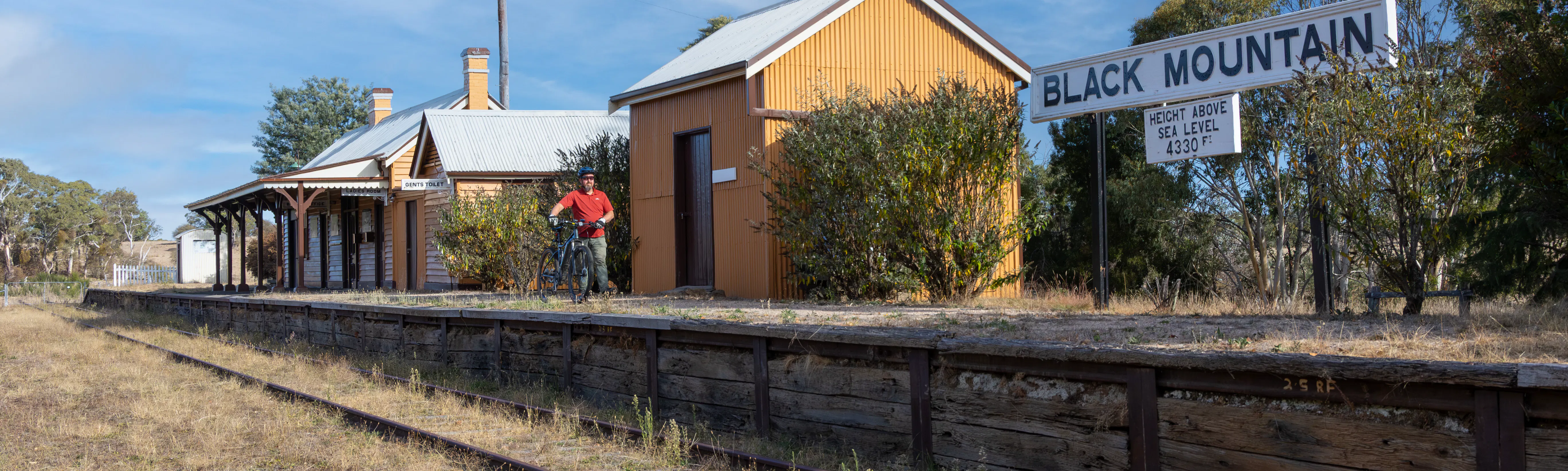
Opportunities for preserving these structures and revitalising the stations are being explored and depending on funding availability there is potential for conversion of the stations into commercial hubs (kiosks, bike shops etc) that service rail trail users and the wider local community.
Are there any remnants of toxic chemicals used on the rail corridor? Is there any risk to rail trail users?
Investigations into potential contaminants associated with past use of the rail corridor are currently underway as part of the Preliminary Works stage.
Operations of Trail
Who will be able to use the rail trail?
Essentially, rail trails can be used for walking and cycling by everyone. Motorcycles will not be permitted on the trail. Decisions around mobility scooters, horses and dogs are yet to be made. During this consultation and any future consultations, we are keen to hear your ideas.
What would happen in an emergency?
Emergency vehicles would have full access to the rail trail. An emergency response plan would be developed in consultation with local police, fire and emergency services and would be incorporated within an overall Rail Trail Management Plan.
Where will trail users go to the toilet?
As yet no decision has been made on this issue. There is the potential to upgrade existing toilet facilities attached to the historic train stations and utilise existing toilet facilities near the rail corridor.
Will there be rubbish bins along the trail?
As yet, no decision has been made on this issue. While the placement of bins may appear to be common sense, evidence shows that bins invite rubbish. Many national park trails do not have bins and operate successfully under the protocol of ‘carry out what you carry in’.
Illegal dumping of rubbish is a problem in some areas of the rail corridor and it is believed it is more prevalent along the rail corridor because the corridor is effectively not used and poorly maintained. With use, illegal dumping along the corridor is likely to become less of an issue.
In other rail trail areas, littering has not been a problem. The Lilydale to Warburton Rail Trail in Victoria and South Australia's Clare Valley Riesling Trail are kept spotless, with little or no signs of litter.
Will people be able to camp on the trail?
As yet, no decision has been made around this issue. However, this is an opportunity that could be explored by entrepreneurial landowners adjacent to the trail.
Adjacent landowners
- Separate rail trail users from farm operations
- clearly delineate areas where access is prohibited
My property backs onto the rail corridor. What if somebody trespasses on my land and gets injured? Am I liable?
Concerns about trespassing are a regular theme for rail trails throughout the world. Concerns are commonly expressed during the initial phases but trespassing is extremely rare, or non-existent, in practice. Typical rail trail users are not the type of people likely to trespass.
A rail trail would be a public thoroughfare, the same as a road. The situation would be no different from somebody trespassing via a road, driveway or the existing disused rail corridor. If somebody trespasses on private land and hurts themselves, the landowner cannot be held liable unless they were shown to be negligent. The onus would be on the trespasser to prove negligence.
Landowners may already have public liability insurance included in their home and contents or farm insurance packages.
Public liability while on the rail corridor would be the responsibility of the trail manager. The trail manager would be required to have public liability insurance in place.
Will a rail trail affect my home and contents/farm insurance premiums?
No. A rail trail would be the same as a road passing your property and would not be a factor in insurance premiums.
What if somebody comes onto my land and steals or damages some of my property?
The same laws that protect people everywhere in NSW would protect rail trail users, adjacent landowners and property, and would be enforceable by police.
Removing existing overgrown vegetation along the rail corridor would minimise hiding places and create long sight distances. The regular presence of rail trail users would provide passive surveillance, reducing the likelihood of crime.
Research and anecdotal evidence suggests conversion of rail trails tends to reduce crime by cleaning up the landscape and attracting people who use the trail for legitimate reasons, such as recreation and transport.
Numerous testimonials from law enforcement officers where rail trails exist confirm that anticipated crimes rarely or never occur.
Is Council going to fence the entire corridor to keep people separate from stock and adjacent private lands?
This issue will be assessed during design on a case-by-case basis and fencing would be installed if it is necessary to:
The fencing requirements along the corridor will be inspected on-site and the adjacent resident/ owner will be consulted during the design process.
My driveway crosses the rail corridor. Will I have 'right of way' at the intersection?
Yes, vehicle access at roads and driveways would take priority. Signage and line-marking would be installed on the rail trail at driveways to show this. Chicanes, or other calming devices, would be installed at trailheads and road crossings with high levels of traffic.
My house is close to the rail line. A rail trail will reduce my privacy. What will be done to avoid this?
Where houses are close to the proposed rail trail, the site would be inspected and the resident/owner consulted. Measures to maintain residents' privacy could be implemented. This might include planting trees to form a screen or, in extreme cases, installing screen fencing or detouring the trail to keep it away from houses.
I keep livestock on my farm adjacent to the rail corridor. Could users of the proposed rail trail spread disease or parasites to my stock?
A Biosecurity Risk Assessment for all primary producers along the rail corridor will be undertaken within the Preliminary Works stage.
For the Tumbarumba Rail Trail, Local Land Services conducted a Biosecurity Risk Assessment that identified all the risks associated with biosecurity and proposed management measures to address them.
The Tumbarumba Biosecurity Risk Assessment can be found at http://murray.lls.nsw.gov.au/biosecurity/disease-control/rail-trail-biosecurity-risk-assessment
What if somebody starts a fire on the Rail Trail?
The rail corridor will be maintained if it becomes a rail trail and will be less prone to bushfire risk. Some landowners have expressed concerns around the risk of unintentional fire-lighting and ways to mitigate this risk will be looked at in detail in the design phase of the project.
A well maintained rail trail has the potential to act as a firebreak and would be more accessible to the Rural Fire Service should there be a fire.
There are a lot of weeds on the rail corridor. What will happen to them? How will they be stopped from spreading?
The corridor will be cleared of obstructing vegetation. Weeds will be identified and disposed of appropriately. Council’s weeds and biosecurity team would likely conduct regular inspections.
A maintenance program for the rail trail would include weed management.
I have paddocks on both sides of the rail corridor and frequently transfer stock across the line. Will I still be able to do this if a rail trail is established?
Yes, existing farm access will be maintained. Gates and fencing will be installed to separate rail trail users from stock being moved across the corridor.
The fencing and stock crossing requirements along the corridor will be inspected on-site and the adjacent resident/ owner will be consulted during the design process.
I have livestock in paddocks next to the corridor. What happens if somebody's dog gets loose and attacks my stock?
If dogs are permitted on the rail trail they would need to be kept on leashes, in accordance with a code of conduct. The Companion Animals Act places responsibilities on all pet owners. A dog in any public place other than an approved off-leash area must be under the effective control of a competent person and restrained by an adequate chain, cord or leash.
Will a Rail Trail decrease the value of my land?
There is no evidence that trails decrease adjacent property values.